How an Image Becomes Real
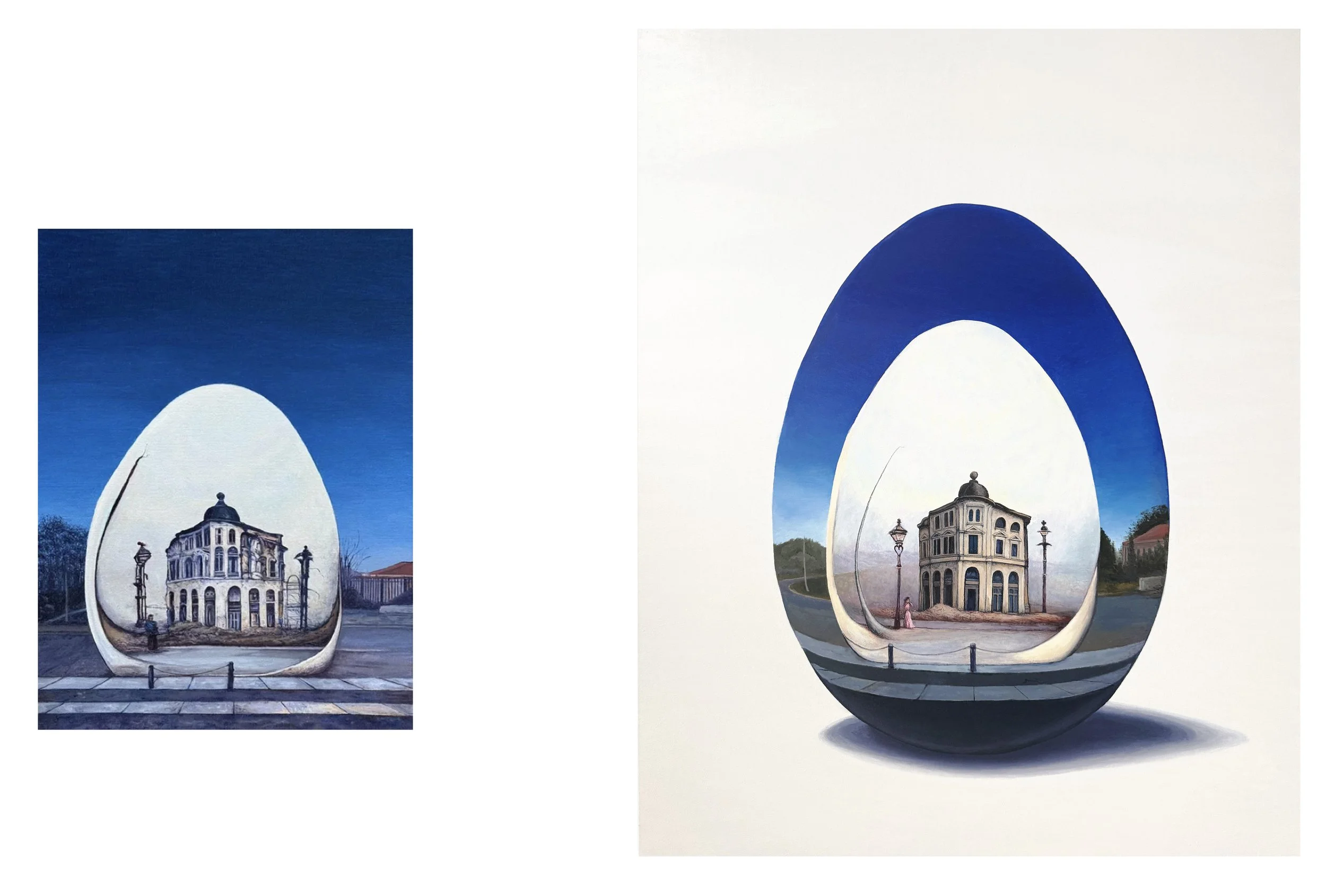
I am interested in how an image becomes real to us. Not simply how an image represents reality, but how something imagined, remembered, desired, misrecognised, accidentally encountered or unconsciously generated can acquire enough perceptual force that it begins to participate in reality.
The usual account of painting seems straightforward:
world → perception → image
Something exists. We see it. We make an image of it.
My paintings often begin somewhere else.
An image appears before I understand it. Two things suddenly belong together. A remembered scene acquires an object that was never originally there. An image returns after years of absence with greater clarity than many actual events. I recognise these combinations before I can explain them.
The sequence reverses:
image → perception → world
Once an image has appeared, it changes what can subsequently be perceived. This is why I do not think of my paintings as illustrations of ideas. The idea often arrives later. The painting begins with recognition: the peculiar conviction that an image is right before I know what it means, what it is, why it is. The question is therefore not primarily, “What does this image represent?” It is: why does this seem to belong here?
That question places my work within the continuing problem of Surrealism. Surrealism proposed that images could reveal forms of thought and perception that precede conscious explanation. But I am increasingly interested not only in where an image comes from, but in what happens after it appears.
How does an image persist?
How does it become memorable?
How does it begin to alter other images?
At what point does something imagined acquire a reality of its own?
One of the clearest examples in my work began with an AI-generated image.
After making thousands of images in Midjourney, collecting my favourites, and forgetting them, blurring them together i memory, one image arrested me, returned to me repeatedly. I did not know why. I did not exhibit it or regard it as a finished artwork. I simply remembered it again and again, for years.
Eventually I painted it. I painted it for myself, without any intention of showing it. It lived in my bedroom as an object for private pleasure and contemplation. Through the slow process of painting, it also changed. The differences from the generated image were not spectacular. They accumulated in the details, the surface, colour, edges and small decisions made over many hours. The image became increasingly particular. This experience complicated my understanding of authorship.
It is often argued that AI cannot make art because a machine possesses no unconscious capable of revelation. But this assumes that the unconscious must reside in the mechanism that produces the initial image. I am not convinced that it does.
Duchamp’s readymades had already broken the necessary connection between artistic authorship and manual fabrication. The artist did not have to make the object. Recognition, selection and repositioning could themselves become artistic acts.
AI images can function in a similar way. Not every generated image is an artwork of note, just as every manufactured urinal was not a Duchamp. What matters is the encounter. Artists made milllikons of paintings, only a smaller number are memorable, noteworthy. The unconscious may not reside in the machine. It may emerge in the question of why this image, rather than another, refuses to disappear. For me, that question has become increasingly important. The image I painted did not finish when the painting was completed. It continued to recur. Later, after a tour of Spainish museums, while looking at that painting from the comfort of my bed, I suddenly imagined it painted onto the surface of an egg. There was no argument leading to the vision. It simply appeared. That new image became another painting. And now, while working in Spain, I am producing another version in which the earlier painting appears again within the new image: located in the background, but placed at its centre.
The image persists. It moved from digital generation into memory, from memory into painting, from painting into contemplation, from contemplation into another involuntary image, and from that image into another painting. There is no simple distinction between original and copy. There is instead an ecology. Images generate images. They migrate between minds, media and objects. They disappear and return. They become hosts for subsequent images. They acquire descendants.
This is one aspect of “ecologies of inception.” The life of an image. Memory plays a central role in this process, but memory itself is not an archive containing fixed records of the past. A memory can continue to develop. In Inland Memory, the initial event was extremely simple. I wrote the word “cheesegrater” in the sand on a beach, and a young friend happened to walk past.
Two years later, I returned to the image and suddenly saw an enormous cheese grater and a painted portrait standing beside him. Those objects had never existed in the original event. Yet once imagined, they seemed strangely necessary, essential, beckoning. The past acquired something. This is one reason I am interested in the uncertain boundary between the real and the imaginary. A remembered thing is absent and present simultaneously. A dream can alter waking behaviour. An imagined object can persist with extraordinary clarity despite never having physically existed. A painting can make such an object available to someone else.
Mental images therefore occupy a strange category. They are not materially present, yet they act upon us. They affect emotion, expectation, memory and perception. They can become part of the architecture of reality.
The paintings often contain another movement as well: things withdraw. Objects become enclosed, obscured, sheltered, covered or displaced. Architecture conceals as much as it reveals. Images appear within other images. Things are present without becoming completely available.
This is the inverse of the same problem. If one question is how something becomes perceptible, another is how something can remain real without becoming completely visible. The hidden thing does not cease to exist. Sometimes concealment intensifies its presence. I do not regard this incompleteness as something painting must resolve. Quite the opposite. The paintings attempt to preserve perceptions that arrive before explanation: relationships between objects that feel exact before their logic can be stated, images whose necessity is sensed before it is understood.
Their task is not necessarily to clarify those images. It is to allow them to become real. And then to see what they produce next.
-
Figueres, Spain, 12 August 2026.